Regional traditions

Traditional Kokeshi

This directory uses the eleven-group index currently published by the Tohoku Bureau of Economy, Trade and Industry. It is a sourced navigation frame—not a promise that every institution, collector or historical catalogue has grouped the field in the same way.

Last reviewed

Look closely · Real objects

Look at the object. Then compare.

Real examples of Zaō Takayu and Nanbu, followed by a source-backed comparison with Yamagata. Start with the proportions, then look at the face and body decoration.

Zaō Takayu Kokeshi

蔵王高湯系こけし
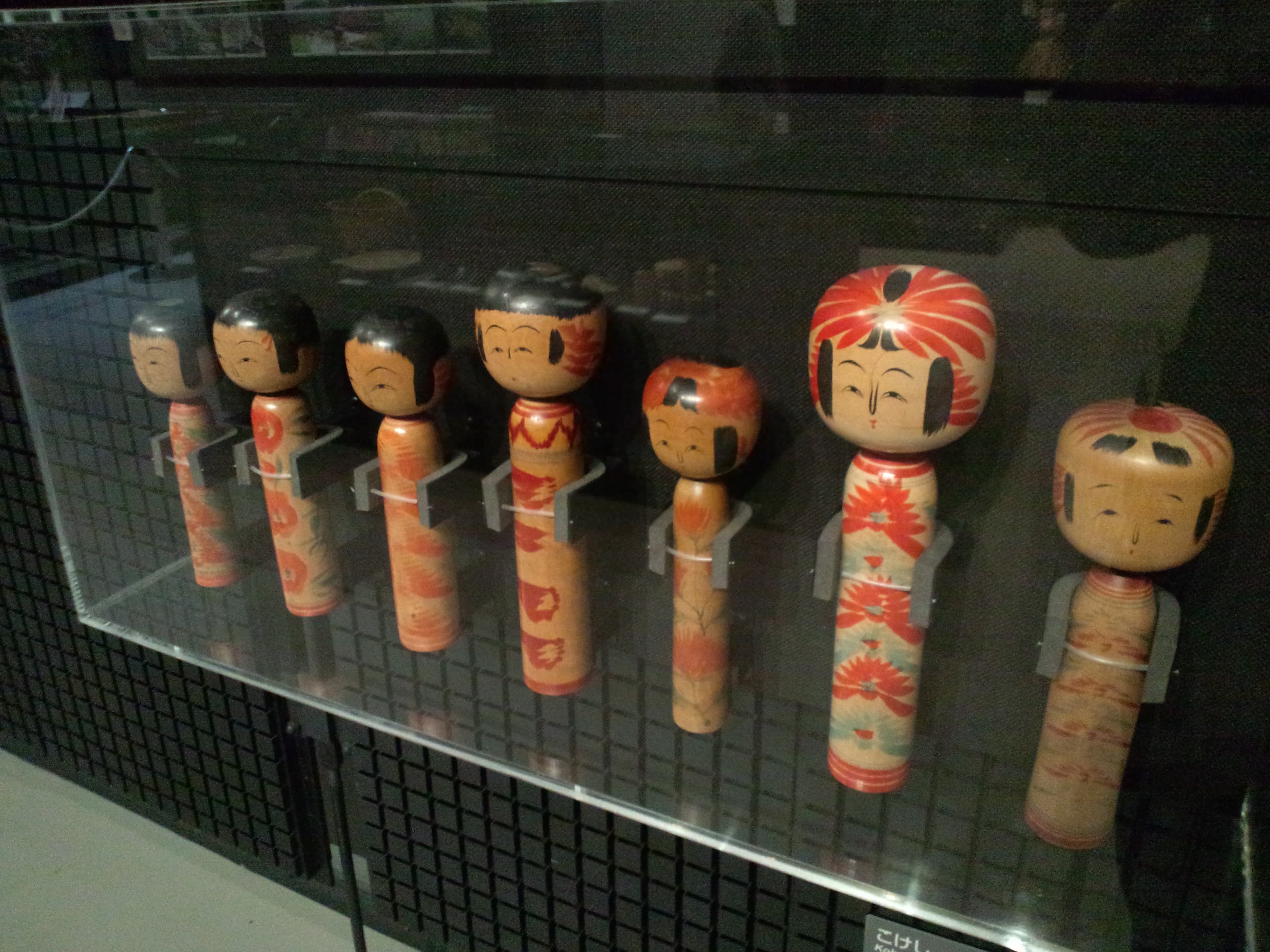
A Zaō Takayu kokeshi in a museum display, with a broad head, red radiating hair ornament and red flowers down its body.

Detail of a Zaō Takayu display photographed at the National Museum of Ethnology, Osaka, in 2014.

The photographer identifies the group as Zaō Takayu. Individual makers and object dates are not supplied; the photograph date is not the age of the doll.

Photograph: Yanajin33 / Wikimedia Commons. · CC BY-SA 4.0 · Cropped view; resized for display
Original photograph and attribution
Photo record checked:

Look at the head and body

Detail views frame the same photograph. No generated detail or retouching has been added. These views retain the photograph’s licence.

Detail from the same photograph: red radiating ornament above the face and black side hair.
Head and hair ornament
Detail from the same photograph: red flower forms down the body, partly crossed by the museum display support.
Painted body

Compare the broad head and red hair ornament with the painted flower forms on the body. Other objects in the full photograph have bob hairstyles: this one example does not define the entire tradition.

Read the Zaō Takayu record →
Nanbu Kokeshi

南部系こけし

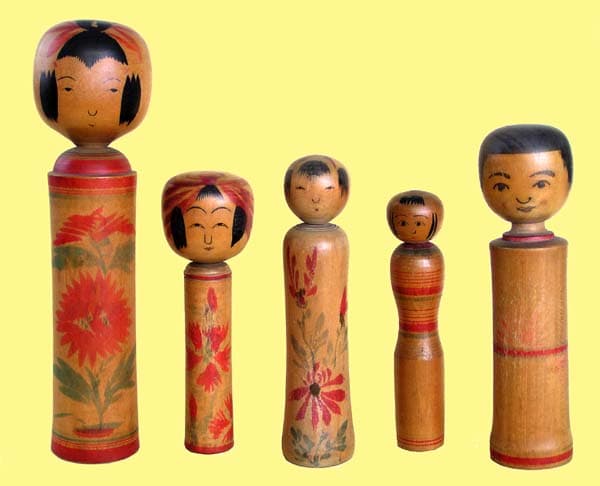
A painted Nanbu kokeshi with a small dark-haired head, a narrowed waist and red horizontal bands.

A painted Nanbu example, fourth from the left in the original group photograph.

Identified as Nanbu by the photographer and owner. The source is only 600 × 486 pixels for the whole group; fine brushwork and signatures cannot be assessed here.

Photograph and collection: Mhashi / Wikimedia Commons. · Public domain — photographer’s dedication · Cropped view; resized for display
Original photograph and attribution
Photo record checked:

Notice the narrowed waist and painted face and bands. This individual example helps explain why “Nanbu” does not mean “always unpainted”. A still photograph cannot demonstrate the movement of the head.

Read the Nanbu record →

These are individual examples, photographed at different scales. They do not represent every maker or period. A photograph can support a comparison of visible features; it cannot by itself prove a maker, date, wood species or value.

Yamagata, Zaō Takayu and Nanbu: what to compare

These descriptions come from the cited museum and local sources in each record. Traits can overlap; compare several features and the object’s provenance together. Do not force or twist a head to test its construction.

TraditionFormPainting and surfaceHead and body joint
Yamagata KokeshiNishida Memorial Museum describes a small head above a thin, straight body, joined by sashikomi construction.Cherry blossoms; Four-petalled plum blossoms in the city guide; Safflower motifs in documented local examplesSashikomi: a separately turned head inserted into the body.
Zaō Takayu KokeshiThe museum describes a thick, straight body, with a narrowed waist in some larger examples. Its head is joined by sashikomi construction.Layered chrysanthemums; Sakura-kuzushi cherry-blossom patterns; Red tegara hair ornament or a black bob hairstyleSashikomi: a separately turned head inserted into the body.
Nanbu KokeshiThe head moves in a loose hamekomi joint. The museum records straight, banded and waisted bodies.Unpainted wood in kinakina examples; Chrysanthemum, peony, dianthus and camellia in painted Hanamaki examplesA loose hamekomi joint lets the head move.

The Yamagata record documents the small head and slender form. A photograph with both confirmed lineage and suitable reuse rights has not yet been secured; its museum and local sources remain available to consult. Read the Yamagata record →

Published tradition records

Current reference frame11 regional groups

The Tohoku Bureau of Economy, Trade and Industry currently lists eleven groups. Historic exhibitions may use another count, so the number is shown with its source rather than presented as timeless.

Search names, regions and documented features. Accents are optional.

Prefecture

Showing 11 of 11 records

Partial research

Fukushima City and Tsuchiyu Onsen, Fukushima Prefecture

Tsuchiyu Kokeshi

土湯系こけし

A Fukushima tradition centred on Tsuchiyu Onsen. The Fukushima Museum describes a snake-eye ring on the crown, a red kase hair ornament and rokuro body lines.

View the research record
Partial research

Zaō Onsen, Yamagata Prefecture

Zaō Takayu Kokeshi

蔵王高湯系こけし

A tradition from Zaō Onsen with a substantial body, layered chrysanthemums or cherry-blossom patterns, and close stylistic ties to Tōgatta. Individual forms vary.

View the research record
Partial research

Yamagata, Yonezawa and Tendō, Yamagata Prefecture

Yamagata Kokeshi

山形系こけし

Small heads, slender bodies and floral painting characterise this tradition originating in Yamagata City. The name identifies a regional lineage, not every kokeshi made in Yamagata Prefecture.

View the research record
Partial research

Hijiori Onsen, Yamagata Prefecture, with related production in Miyagi

Hijiori Kokeshi

肘折系こけし

A regional group centred on Hijiori Onsen and also represented in Miyagi’s official five-group craft designation. Its cross-prefectural history requires more than a single-place label.

View the research record
Partial research

Naruko Onsen, Miyagi Prefecture

Naruko Kokeshi

鳴子系こけし

A Miyagi tradition associated with Naruko Onsen and included in the national designation for Miyagi traditional kokeshi. The current record connects the lineage to official craft and museum sources.

View the research record
Partial research

Sendai and Sakunami Onsen, Miyagi Prefecture

Sakunami Kokeshi

作並系こけし

A Miyagi tradition linked with Sendai and Sakunami. Miyagi official material describes a slender form and a crab-like chrysanthemum motif, while individual makers continue to vary within the lineage.

View the research record
Partial research

Shiroishi and the Yajirō area, Miyagi Prefecture

Yajirō Kokeshi

弥治郎系こけし

A Miyagi tradition associated with the former woodturning settlement of Yajirō near Shiroishi. A municipal facility preserves and presents the local craft context.

View the research record
Partial research

Tōgatta Onsen, Miyagi Prefecture

Tōgatta Kokeshi

遠刈田系こけし

A Miyagi tradition associated with Tōgatta Onsen. Official prefectural material identifies a large head, slender body and red head decoration among documented characteristics.

View the research record
Partial research

Yuzawa and Kijiyama, Akita Prefecture

Kijiyama Kokeshi

木地山系こけし

An Akita tradition with Kijiyama and Kawatsura branches. Akita’s official craft record documents a one-piece head-and-body construction and a history tied to woodturners’ movement within the region.

View the research record
Partial research

Morioka, Hanamaki and other Iwate communities

Nanbu Kokeshi

南部系こけし

An Iwate tradition with loose-fitting, movable heads. Unpainted kinakina and painted floral examples belong to its history; an absence of paint is not a rule for every Nanbu kokeshi.

View the research record
Partial research

Kuroishi, Ōwani and Hirosaki, Aomori Prefecture

Tsugaru Kokeshi

津軽系こけし

An Aomori tradition encompassing production in Kuroishi, Ōwani and Hirosaki. Aomori Prefecture documents one-piece construction and local variations including Nuruyu and Hirosaki work.

View the research record

Evidence

Sources and further reading

  1. official
    Miyagi Traditional Kokeshi and the Eleven Tohoku Groups

    Tohoku Bureau of Economy, Trade and Industry

    View source (opens in a new tab)Accessed 2026-08-31The official endpoint blocks some automated and overseas-network requests; its current indexed record was rechecked on 2026-09-06.
  2. official
    Hirosaki Kokeshi and Wooden Toys

    Aomori Prefectural Government · 2025-04-01

    View source (opens in a new tab)Accessed 2026-08-31
  3. museum
    Kokeshi: From Folk Art to Art Toy — Traditional

    Japanese American National Museum

    View source (opens in a new tab)Accessed 2026-08-31