- Japanese name
- 蔵王高湯系こけし
- Reading
- zaō-takayu-kei kokeshi
- Main region
- Zaō Onsen, Yamagata Prefecture
- Verification
- partial
A photographed example
Look at the object
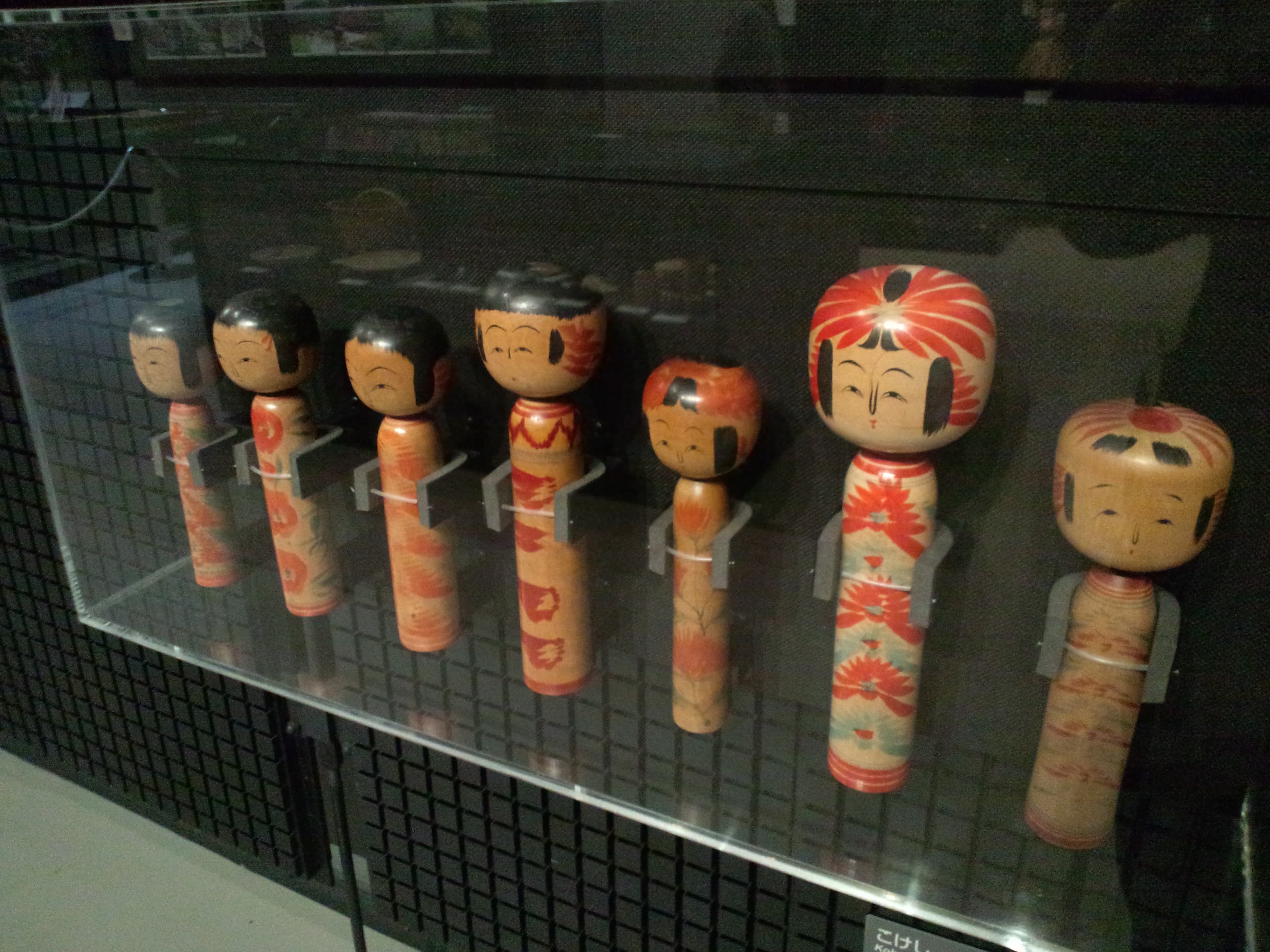
Detail of a Zaō Takayu display photographed at the National Museum of Ethnology, Osaka, in 2014.
The photographer identifies the group as Zaō Takayu. Individual makers and object dates are not supplied; the photograph date is not the age of the doll.
Photograph: Yanajin33 / Wikimedia Commons. · CC BY-SA 4.0 · Cropped view; resized for display
Original photograph and attribution
Photo record checked:

Look at the head and body
Detail views frame the same photograph. No generated detail or retouching has been added. These views retain the photograph’s licence.
These are individual examples, photographed at different scales. They do not represent every maker or period. A photograph can support a comparison of visible features; it cannot by itself prove a maker, date, wood species or value.
Explore the photographs and three-tradition comparison →Visual checklist
How to recognise Zaō Takayu Kokeshi
- FormA thick, straight body; some large examples have a narrowed waist.
- HeadA bob hairstyle or a red tegara hair ornament.
- ConstructionSashikomi: a separately turned head inserted into the body.
- BodyLayered chrysanthemums and sakura-kuzushi cherry-blossom patterns.
Source: Nishida Memorial Museum. A match suggests a regional group; it does not authenticate a maker, date or value. Compare the base inscription with the signed kokeshi guide.
Read the differences
Names, neighbours and variations
Compare the whole form with Tōgatta
The Yamagata City guide describes a thicker body alongside Tōgatta-influenced painting. The two traditions share hair and flower motifs, so a red head ornament alone is not a reliable distinction. Compare the form and documented provenance together.
Sources: Yamagata City — Takara no Yamagata
More than one body shape
Yamagata Prefecture's craft guide describes a rounded body that is shorter and broader than Yamagata examples, with a larger head. The museum also records straight and waisted forms. These accounts support variation rather than one compulsory silhouette.
Sources: Yamagata Prefecture; Nishida Memorial Museum
Published evidence fields
What the reviewed sources support
History
Nishida Memorial Museum describes the Zaō tradition as developing from Tōgatta. Yamagata City identifies Zaō Onsen as its place of origin, distinct from the city-centre Yamagata tradition.
Form and construction
The museum describes a thick, straight body, with a narrowed waist in some larger examples. Its head is joined by sashikomi construction.
Documented motifs
- Layered chrysanthemums
- Sakura-kuzushi cherry-blossom patterns
- Red tegara hair ornament or a black bob hairstyle
Omitted fields remain under review. These notes are context, not a visual authentication key.
Place network
Research the region
Questions
Zaō Takayu Kokeshi: common questions
- Where is Zaō Takayu Kokeshi made?
- Zaō Onsen, Yamagata Prefecture. Zaō Takayu Kokeshi is one of the eleven traditional kokeshi groups listed by the Tohoku Bureau of Economy, Trade and Industry.
- How can you recognise Zaō Takayu Kokeshi?
- Form: A thick, straight body; some large examples have a narrowed waist. Head: A bob hairstyle or a red tegara hair ornament. Construction: Sashikomi: a separately turned head inserted into the body. Body: Layered chrysanthemums and sakura-kuzushi cherry-blossom patterns. Individual makers vary within these rules, so the features suggest a group rather than prove a maker or date.
Keep researching
Collecting and buying with evidence
Evidence
Sources and further reading
- officialMiyagi Traditional Kokeshi and the Eleven Tohoku Groups
Tohoku Bureau of Economy, Trade and Industry
View source (opens in a new tab)Accessed 2026-08-31The official endpoint blocks some automated and overseas-network requests; its current indexed record was rechecked on 2026-09-06. - officialYamagata Traditional Kokeshi
Yamagata City
View source (opens in a new tab)Accessed 2026-08-31 - museumIntroduction to Kokeshi — Regional Forms and Construction
Nishida Memorial Museum
View source (opens in a new tab)Accessed 2026-11-04The museum uses a twelve-group classification. Its Yamagata, Zao and Nanbu sections support the cited features; its classification count does not replace this site's separately sourced eleven-group index. - officialTraditional Kokeshi of Yamagata
Yamagata City — Takara no Yamagata
View source (opens in a new tab)Accessed 2026-11-04 - officialYamagata Kokeshi — Yamagata Traditional Crafts
Yamagata Prefecture
View source (opens in a new tab)Accessed 2026-11-04Used for the comparison of body proportions. The historical sentence naming Fukushima and Akiu together has not been adopted; its geographical wording needs clarification.
Where to buy · read before you click
Shop this kokeshi style—with context
These are current keyword-matched eBay listings, not objects authenticated by Kokeshi Atlas. A seller’s title may be incomplete or mistaken, so compare observable features and evidence before treating an item as Zaō Takayu Kokeshi.
Affiliate disclosure: This site may earn a commission from qualifying purchases made through eBay links, at no additional cost to you.
Listings are supplied by eBay and may change at any time. Prices shown are current asking prices or current auction bids—not sold prices, appraisals or proof of attribution.