- Japanese name
- 南部系こけし
- Reading
- nanbu-kei kokeshi
- Main region
- Morioka, Hanamaki and other Iwate communities
- Verification
- partial
A photographed example
Look at the object
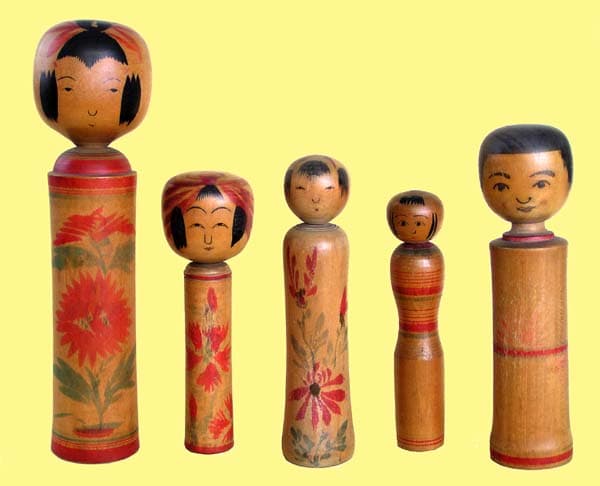
A painted Nanbu example, fourth from the left in the original group photograph.
Identified as Nanbu by the photographer and owner. The source is only 600 × 486 pixels for the whole group; fine brushwork and signatures cannot be assessed here.
Photograph and collection: Mhashi / Wikimedia Commons. · Public domain — photographer’s dedication · Cropped view; resized for display
Original photograph and attribution
Photo record checked:


These are individual examples, photographed at different scales. They do not represent every maker or period. A photograph can support a comparison of visible features; it cannot by itself prove a maker, date, wood species or value.
Explore the photographs and three-tradition comparison →Visual checklist
How to recognise Nanbu Kokeshi
- FormStraight, banded or waisted bodies occur.
- ConstructionA loose hamekomi joint lets the head move.
- BodyUnpainted kinakina are part of the tradition; the museum highlights their form and wood surface.
Source: Nishida Memorial Museum. A match suggests a regional group; it does not authenticate a maker, date or value. Compare the base inscription with the signed kokeshi guide.
Read the differences
Names, neighbours and variations
Unpainted does not mean unfinished
Iwate Prefectural Museum records an unpainted kinakina, accession 099847, measuring 30 cm in height. The record names its maker and transcribes the base inscription. This is a documented object, not evidence that all plain wooden dolls are Nanbu.
Sources: Iwate Prefectural Museum
Painted examples also belong to the tradition
Hanamaki's tourism association documents floral painting as a later development under the influence of other groups. Face and body decoration therefore do not, by themselves, rule out Nanbu. Compare the construction and an attributed reference object together.
Sources: Hanamaki Tourism Association
Published evidence fields
What the reviewed sources support
History
Hanamaki's tourism association describes an earlier unpainted form without facial or body decoration, followed by painted examples influenced by other traditions. Its account includes chrysanthemum, peony, dianthus and camellia motifs.
Form and construction
The head moves in a loose hamekomi joint. The museum records straight, banded and waisted bodies.
Documented motifs
- Unpainted wood in kinakina examples
- Chrysanthemum, peony, dianthus and camellia in painted Hanamaki examples
Omitted fields remain under review. These notes are context, not a visual authentication key.
Place network
Research the region
Questions
Nanbu Kokeshi: common questions
- Where is Nanbu Kokeshi made?
- Morioka, Hanamaki and other Iwate communities. Nanbu Kokeshi is one of the eleven traditional kokeshi groups listed by the Tohoku Bureau of Economy, Trade and Industry.
- How can you recognise Nanbu Kokeshi?
- Form: Straight, banded or waisted bodies occur. Construction: A loose hamekomi joint lets the head move. Body: Unpainted kinakina are part of the tradition; the museum highlights their form and wood surface. Individual makers vary within these rules, so the features suggest a group rather than prove a maker or date.
Keep researching
Collecting and buying with evidence
Evidence
Sources and further reading
- officialMiyagi Traditional Kokeshi and the Eleven Tohoku Groups
Tohoku Bureau of Economy, Trade and Industry
View source (opens in a new tab)Accessed 2026-08-31The official endpoint blocks some automated and overseas-network requests; its current indexed record was rechecked on 2026-09-06. - officialFolk Toys — Iwate Cultural Information Encyclopedia
Iwate Prefecture
View source (opens in a new tab)Accessed 2026-08-31 - museumCurator Lecture: The Appeal of Nanbu Kokeshi
Hanamaki City Museum · 2024-04-30
View source (opens in a new tab)Accessed 2026-08-31 - museumIntroduction to Kokeshi — Regional Forms and Construction
Nishida Memorial Museum
View source (opens in a new tab)Accessed 2026-11-04The museum uses a twelve-group classification. Its Yamagata, Zao and Nanbu sections support the cited features; its classification count does not replace this site's separately sourced eleven-group index. - officialNanbu Kokeshi (Hanamaki Kokeshi)
Hanamaki Tourism Association
View source (opens in a new tab)Accessed 2026-11-04 - museumTraditional Kokeshi (Nanbu Group), Accession 099847
Iwate Prefectural Museum
View source (opens in a new tab)Accessed 2026-11-04Object record for an unpainted kinakina with a named maker and a transcribed base inscription. The museum retains copyright in the photographs; this citation is not a reproduction licence.
Where to buy · read before you click
Shop this kokeshi style—with context
These are current keyword-matched eBay listings, not objects authenticated by Kokeshi Atlas. A seller’s title may be incomplete or mistaken, so compare observable features and evidence before treating an item as Nanbu Kokeshi.
Affiliate disclosure: This site may earn a commission from qualifying purchases made through eBay links, at no additional cost to you.
Listings are supplied by eBay and may change at any time. Prices shown are current asking prices or current auction bids—not sold prices, appraisals or proof of attribution.